The story of Pilates is almost always told as one man's story. Joseph Pilates invented the method, designed the equipment, wrote the books, and built the studio. That version is not wrong, but it is incomplete. Standing beside him for over forty years was Clara Pilates, born Anna Clara Zeuner, who did something Joseph could not easily do alone: she made Contrology teachable.
Clara was not a silent partner or a background figure. She co-taught every day in the studio at 939 Eighth Avenue in Manhattan. She managed the correspondence, the finances, and the scheduling. After Joseph died in 1967, she continued running the studio for several more years and played a direct role in selecting the person who would carry the work forward. Without Clara, it is entirely possible that the Pilates method would have died with its founder.
How they met
Joseph and Clara met in 1926 aboard a ship traveling from Europe to New York. The details of this meeting have been told in several versions over the decades, but the core story is consistent across sources: Clara was dealing with chronic pain, possibly arthritic in nature, and Joseph offered to help her during the voyage. By the time they arrived in New York, they had decided to build a life together.
Clara's background before meeting Joseph is one of the murkier areas of Pilates history. Different sources describe her as either a nurse or a kindergarten teacher, and some accounts identify her as a nursery school teacher who worked with chronically ill children. What is clear is that she brought a caregiver's temperament to the studio. Whether her training was formal or experiential, Clara understood how to work with people in pain, and that instinct became central to how Contrology was taught in practice.
The teacher Joseph was not
Joseph Pilates was, by most accounts, a forceful and sometimes impatient instructor. He was a showman, a physical culturist, and a true believer in his system. He could demonstrate exercises with stunning precision and expected his clients to follow. But not every client responded well to that intensity. Dancers recovering from injuries, older clients managing chronic conditions, and beginners encountering the equipment for the first time often needed something different.
Clara provided it. Multiple sources from the Pilates community describe her as the person who translated Joseph's demands into language clients could understand and follow. She is often referred to in the Pilates lineage community as "the true teacher of Pilates." Her approach was patient, adaptive, and sensitive to what each body could actually do on a given day.
This was not a minor contribution. The Pilates method succeeded in part because it worked for injured and limited bodies, not just for athletes and performers. Clara's ability to modify exercises and meet clients where they were helped establish the rehabilitative dimension that distinguishes Pilates from most other exercise systems. Her nursing or caregiving background gave her an intuitive understanding of what movements a body could tolerate and when to pull back.
Life at 939 Eighth Avenue
The Pilates studio at 939 Eighth Avenue in Manhattan occupied the same building as several dance studios, including spaces used by the New York City Ballet. This proximity is part of why dancers became the method's most visible early adopters. George Balanchine, the legendary choreographer, personally sent injured dancers to Joseph and Clara for rehabilitation.
Inside the studio, Clara handled much of the daily operation. She managed the books, answered correspondence, and kept the studio organized while Joseph focused on teaching, inventing, and refining his equipment. Their division of labor was practical: Joseph was the visionary and inventor; Clara was the operator and interpreter.
Letters from Clara to fellow teacher Carola Trier, preserved by the Rhinebeck Pilates research archive, offer a glimpse into her personality and dedication. In one letter, Clara mentions injuring her foot while teaching, writing that it happened "while I was teaching control." The correspondence reveals a woman who stayed deeply connected to both the practice and the community of teachers around it, exchanging holiday cards, photos, and professional updates with her colleagues for years.
After Joseph: 1967-1977
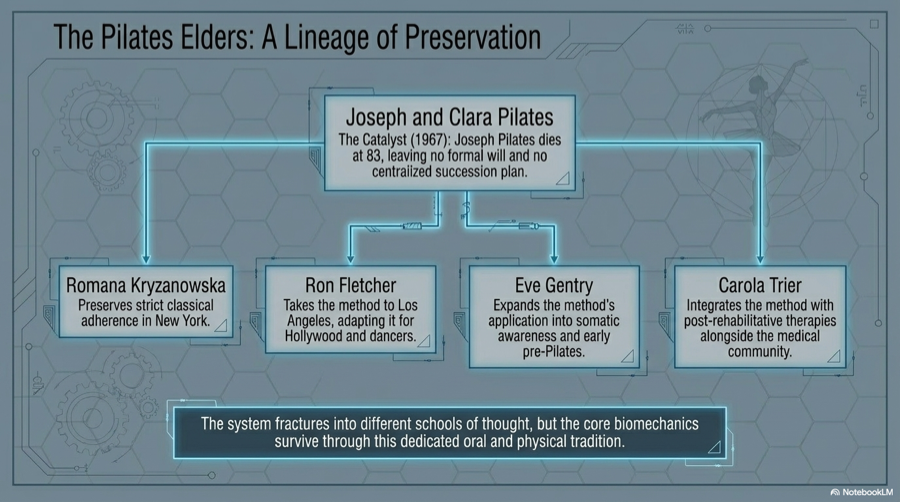
Joseph Pilates died in 1967 at the age of 83. He left no will and designated no formal line of succession for the Contrology method. This could have been the end of the story. Instead, Clara continued to teach and run the studio.
For the next several years, Clara kept the 939 Eighth Avenue studio open. She was in her eighties, and there were limits to how much she could do physically, but she remained present and active. During this period, she worked alongside Romana Kryzanowska, whom Joseph and Clara had trained since the early 1940s. Romana had returned to New York in 1958 after years in Peru and had been working closely with both Joseph and Clara in the studio's final decade.
Around 1970, Clara brought Romana in as director of what was by then known as "The Pilates Studio." In 1971, a partnership involving Kryzanowska and a group of investors purchased the studio's assets from Clara, allowing operations to continue under new ownership. Clara continued to teach until her death in 1977, at approximately 95 years of age. Only then did Romana become the sole director, carrying forward the method that Clara had helped preserve through its most vulnerable decade.
Jay Grimes, a first-generation Pilates elder who trained with Joseph, Clara, and Romana in New York, has spoken about Clara's role during this period with particular clarity. He has noted that while Clara knew the work deeply, she was quiet about it. Joseph was the missionary, the evangelist for the method. Clara was the one who made sure it kept running, day after day, client after client.
Why her story matters for the site
For a history site, Clara's story is essential for several reasons. First, it corrects a genuinely incomplete historical record. Most Pilates history content online devotes a paragraph or two to Clara before returning to Joseph. A dedicated article establishes this site as a source that takes the full story seriously.
Second, Clara's role illuminates something important about how movement methods survive. Invention is not enough. A method also needs translation, adaptation, and continuity. Clara provided all three. She translated Joseph's vision into teachable form, adapted it for bodies that did not move like Joseph's, and ensured continuity through the most precarious period in the method's history.
Third, her story connects to the broader narrative of women in the Pilates lineage. Many of the first-generation teachers who carried the method forward after Joseph's death were women: Romana Kryzanowska, Kathy Grant, Eve Gentry, Lolita San Miguel, Carola Trier, and Mary Bowen among them. Clara was the first link in that chain. Understanding her contribution reframes the entire lineage.
Free guide
Get the Pilates Starter Decision Guide
Still choosing between class styles, equipment, and studio language? The free guide turns the history into a practical first-class decision.
Powered by MailerLite. You can unsubscribe at any time.
Sources and further reading
- Pilates Anytime: Romana Kryzanowska Timeline.
- Wikipedia: Romana Kryzanowska.
- Rhinebeck Pilates: Clara Pilates Research Collection.
- Flow Pilates & Wellness: Love for Clara Pilates.
- Club Pilates: Clara Pilates - International Women's Day.
- Pilates by the Bay: Women in Pilates History.
- Animo Pilates: About Romana Kryzanowska (includes Clara references from Jay Grimes).
- Pilates Method Alliance: Pilates History.
- Joseph H. Pilates and William J. Miller, Return to Life Through Contrology, 1945.