Joseph and Clara Pilates' New York studio sat in a cultural neighborhood where dancers, performers, and movement professionals could find it. That location mattered. The method did not spread first through mass fitness chains. It spread through bodies that needed to perform, recover, and keep working.
Dancers were ideal early adopters because they already understood discipline and nuance. They did not need to be convinced that small adjustments matter. They needed training that could build strength, restore balance, and protect the body without dulling coordination or artistry.
This is why the dance connection is not an ornamental detail. It explains how Pilates earned authority. When performers trusted the studio, the method became associated with serious movement intelligence rather than ordinary exercise.
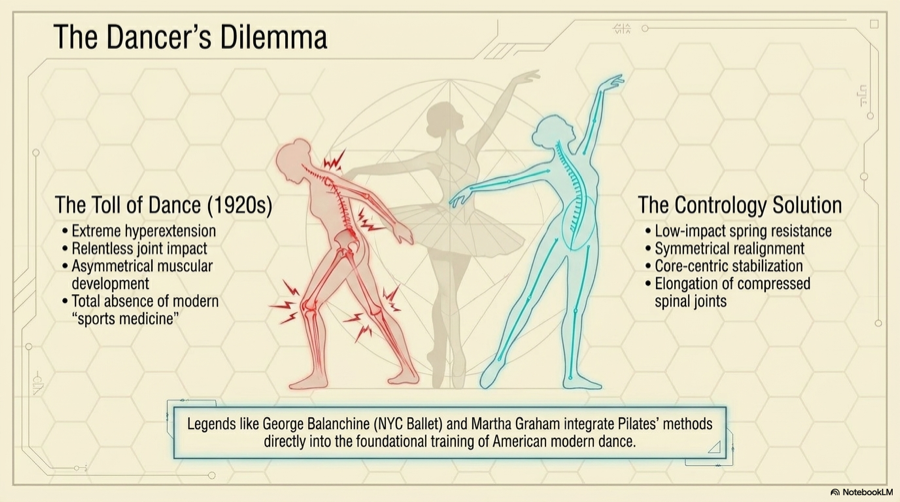
The dancer's dilemma
Dance asks the body to be strong and mobile at the same time. It demands extension, turnout, balance, spinal control, and repeated rehearsal under fatigue. Generic conditioning can help, but it can also add stiffness or reinforce compensations. Pilates offered a different proposition: build power through precision.
Historical accounts often mention figures and circles connected to Martha Graham and George Balanchine. The important point for the site is broader: dancers became a bridge between Joseph Pilates' private studio world and a larger American movement culture.
Why this article belongs in the SEO plan
The dance story gives the site a cultural angle. It can rank for history searches, but it also gives modern dancers, teachers, and students a reason to stay. It explains why Pilates still feels at home in dance departments, rehearsal spaces, and performance recovery programs.
Free guide
Get the Pilates Starter Decision Guide
Still choosing between class styles, equipment, and studio language? The free guide turns the history into a practical first-class decision.
Powered by MailerLite. You can unsubscribe at any time.
Sources and further reading
- Pilates Method Alliance: Pilates History.
- Britannica: Pilates.
- Project source: The Biomechanical Dossier, slide deck.