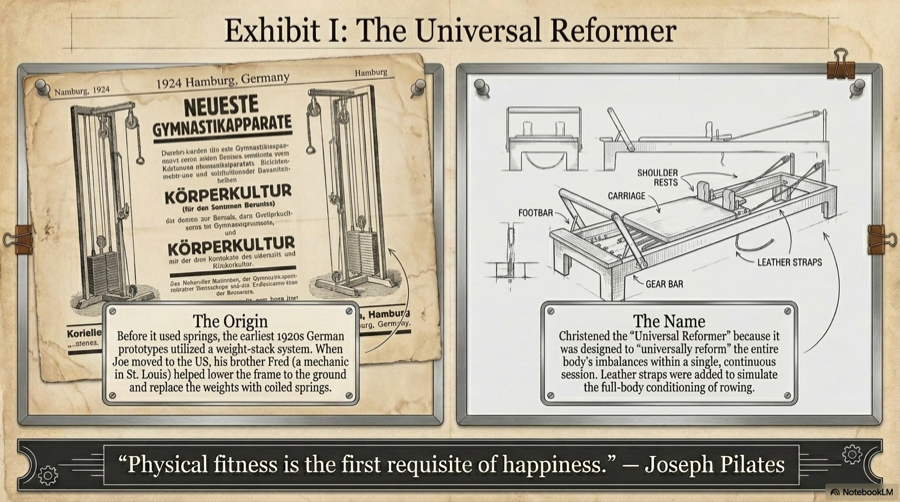
A home Reformer is not a small accessory. It is furniture, exercise equipment, and a teaching system in one object. That is why this guide starts with history instead of a ranking. Joseph Pilates' equipment was built to give the body feedback through springs, straps, a moving carriage, and a fixed frame. The best home choice is the one that preserves enough of that feedback for the way you will actually practice.
For most beginners, the first step is not buying a machine. It is taking a few private, semi-private, or beginner Reformer classes. You learn what spring resistance feels like, how much instruction you need, and whether the apparatus is energizing or stressful. The purchase starts to make sense only when you know you will use it consistently and have a safe place to leave it set up.
Three categories to compare
Classical-style studio Reformers usually appeal to people who want a traditional feel, a fixed setup, and a lineage-oriented practice. They often look closer to archival studio equipment and may assume more teacher guidance. They can be beautiful and durable, but they are not usually the cheapest or most flexible home choice.
Contemporary studio Reformers from makers such as Balanced Body and Merrithew / STOTT often emphasize adjustability, education programs, accessories, and broader body accommodation. This category is common in contemporary studios, clinical settings, and teacher-training environments. It is often the safest category to evaluate if you want a serious home machine but are not trying to replicate a classical studio exactly.
Budget and foldable Reformers solve the obvious home problems: space and cost. They are easier to store and easier to justify financially, but the tradeoff is usually feel. Before choosing one, ask whether the carriage tracks smoothly, whether the frame feels stable, how the springs are replaced, and whether the machine supports the exercises you expect to do.
| Category | Typical fit | Watch closely | Good next step |
|---|---|---|---|
| Classical-style | Lineage-focused practice and teacher-led work. | Cost, footprint, and whether the fixed setup suits your body. | Try a classical studio session first. |
| Contemporary studio | Serious home users who want adjustability and broad exercise options. | Accessory creep, total footprint, and delivery logistics. | Check Balanced Body options Check Merrithew options |
| Budget foldable | Small spaces, lighter routines, and cautious first purchases. | Frame stability, carriage travel, springs, warranty, and resale value. | Search budget Reformers |
What actually matters
Footprint comes first. Measure the machine, the carriage travel, and the space around it. A Reformer that technically fits but leaves no room to mount, dismount, or move around safely will not become a daily habit. If you live in a shared apartment, also think about noise, storage, and whether folding the equipment after every session will make practice less likely.
Spring system comes next. The spring is the apparatus' voice. Different manufacturers use different spring lengths, colors, and resistance progressions. Do not assume that all machines feel the same because they use springs. If you have been taught on one studio brand, switching categories can change the body memory of familiar exercises.
Finally, evaluate support. A home Reformer needs assembly instructions, replacement parts, education materials, and a realistic path to service. This matters more than a small difference in price range. A cheaper machine can become expensive if it cannot be repaired or if it encourages unsafe improvisation.
A cautious buying rule
Buy the least equipment that supports a real routine. If you are still deciding whether Pilates belongs in your life, pay for instruction. If you already practice weekly and want more access, compare serious home machines. If your goal is occasional movement between studio sessions, a mat, small props, and online instruction may be a better first investment.
Related reading: the history of the Reformer, the Cadillac, and the beginner cost comparison.
Quick questions
Should a beginner buy a Reformer first?
Usually not. A few taught sessions are the best first purchase because they show whether the apparatus, space, and setup fit your body and routine.
Are budget foldable Reformers the same as studio equipment?
No. Budget machines can be useful for light home practice, but they usually differ in carriage feel, frame stability, spring behavior, and long-term serviceability.
Which brand is historically closest to classical Pilates?
Classical wooden Reformers are closest to the older studio look and feel, while contemporary manufacturers often emphasize adjustability, portability, or clinical use.