You're browsing studio websites. One says "classical Pilates." Another says "contemporary" or "modern." Both mention Joseph Pilates. Both use reformers. Both talk about core strength, controlled movement, and mind-body connection.
So what's actually different?
The short answer: the difference is not about quality. It's about philosophy, lineage, and how each tradition thinks about preserving versus adapting the work that Joseph and Clara Pilates built nearly a century ago.
The Common Root — Contrology
Both classical and modern Pilates trace back to a single source: a German-born physical culturist named Joseph Pilates and his wife and teaching partner, Clara. Together, they built what Joseph called Contrology — a system of corrective exercise that combined breath work, precise movement, and purpose-built equipment — into a New York studio method beginning in the 1920s.
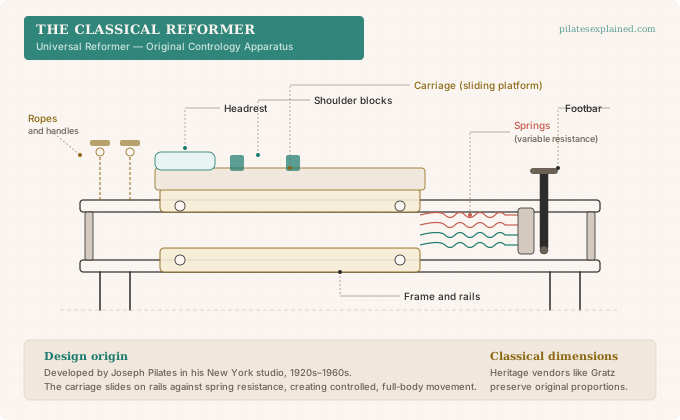
Joseph designed the equipment himself. The Universal Reformer, the Cadillac (or Trapeze Table), the Wunda Chair, and the barrel family were all born in that studio, shaped by constraint, resourcefulness, and decades of refinement. Clara, often underappreciated in popular retellings, was the day-to-day teacher who kept the method alive in the studio and continued the work after Joseph's death in 1967.
The first-generation teachers who studied directly with the couple — Romana Kryzanowska, Kathy Grant, Ron Fletcher, Eve Gentry, Lolita San Miguel, Jay Grimes, and others now known as the Elders — became the living links between the original work and everything that followed. If you've read our article on the Pilates Elders and Lineage, you know how much of the method's survival depended on these individual teachers and their commitment to passing it forward.
This shared root matters because it means classical and contemporary Pilates are not two different methods. They are two branches of the same tree.
What Makes Pilates "Classical"
Classical Pilates is the method at its most preserved. Studios and teachers in this tradition prioritize fidelity to the original Contrology work: the recognizable repertoire, the lineage-based sequencing, the full-apparatus progression that Joseph and Clara taught.
Authority in the classical world flows through teachers, not through a central regulator. A classical instructor's training is typically rooted in one of the Elder lineages — Romana's school, Jay Grimes' tradition, or another direct transmission from someone who learned the work in the original studio. That teacher-to-teacher continuity is the backbone of what makes something "classical."
In practice, a classical session often feels like a coherent, ordered, full-body method. You'll typically work through a progression that touches the mat, the Reformer, the Cadillac, the Chair, and the barrels — not as isolated exercises, but as a system that builds on itself. Sessions are historically private or semi-private, with the teacher guiding your progression based on where you are in the work.
The equipment itself matters in this tradition. Classical vendors like Gratz and the Contrology line by Balanced Body emphasize original dimensions, spring tension, and the feel of the original apparatus. A classical Reformer is not just a piece of equipment; it's a specific design with a specific intention.
This is preservation, not resistance to change. Classical teachers view the original system as something complete — a fully developed method that doesn't need modernization to be effective.
What Makes Pilates "Modern" or "Contemporary"
Contemporary Pilates retains the foundation Joseph and Clara built, but adapts it with modern biomechanics, rehabilitation science, and scalable teaching formats.
The legal turning point that made this expansion possible was the 2000 federal court ruling in Pilates, Inc. v. Current Concepts, Inc., which held that "Pilates" is a generic term — the common name for a method of exercise, not a protected trademark. That ruling opened the field legally, allowing many schools, equipment manufacturers, and studio brands to operate under the Pilates name without licensing it from a single owner.
What followed was an institutional flourishing. STOTT PILATES, founded by Moira Merrithew, became one of the clearest voices for a contemporary approach, explicitly calling itself "the contemporary approach to the original Pilates method" and emphasizing neutral spinal alignment informed by modern exercise science. BASI, founded by Rael Isacowitz in 1989, built a global education ecosystem with over 50,000 graduates. Balanced Body developed a comprehensive 520-hour teacher training path.
And then came the franchise dimension. Club Pilates, founded in 2007, represents the mass-market evolution of contemporary Pilates. With over 1,200 studios operational by the end of 2024, Club Pilates brought group reformer classes, membership-based pricing, and standardized programming to a much broader audience. Their model describes itself as "pure to Joseph Pilates' original Reformer-based Contrology Method" but "modernized with group practice and expanded state-of-the-art equipment."
In practice, a contemporary class often feels more customizable and therapist-adjacent than a classical session. Instructors may reorder exercises around your anatomy, modify work for injuries or special populations, and draw on cueing systems informed by physical therapy. The format ranges from intimate private sessions to group classes with up to twelve people on reformers.
The instructor pipeline reflects this diversity. Where classical training flows through lineage, contemporary training flows through curriculum: structured programs with defined hours, anatomy education, and assessment standards. The Pilates Method Alliance and the National Pilates Certification Program provide an additional quality layer across the entire field.
Which One Should You Choose?
This isn't a ranking. It's a question of what you value.
If you value historical depth, system integrity, and a close teacher-student relationship, classical Pilates may resonate with you. You'll be learning the method in something close to its original form, guided by a teacher whose training traces back through living links to the founders.
If you value adaptability, evidence-informed movement, and group accessibility, contemporary approaches offer that. You'll find more options for class format, price point, and physical accommodation — from rehab-focused private sessions to franchise group classes.
Many practitioners start with one and explore the other over time. The methods are complementary, not competing. A classical session teaches you the discipline and coherence of the original system. A contemporary class teaches you how that system can bend to meet your body where it is.
The important thing is that both are Pilates. Both descend from the same work, the same equipment family, and the same core principles. The difference is in emphasis, not in legitimacy.
But what about Lagree? You've seen the Megaformer classes on Instagram. In our next post, we explain why Lagree isn't a Pilates method — and what it actually is.
Use this with the comparison table
This article gives the context behind the homepage comparison guide. After reading, compare the methods side by side in the Classical, Modern, and Lagree table.
Free guide
Get the Pilates Starter Decision Guide
Still choosing between class styles, equipment, and studio language? The free guide turns the history into a practical first-class decision.
Powered by MailerLite. You can unsubscribe at any time.