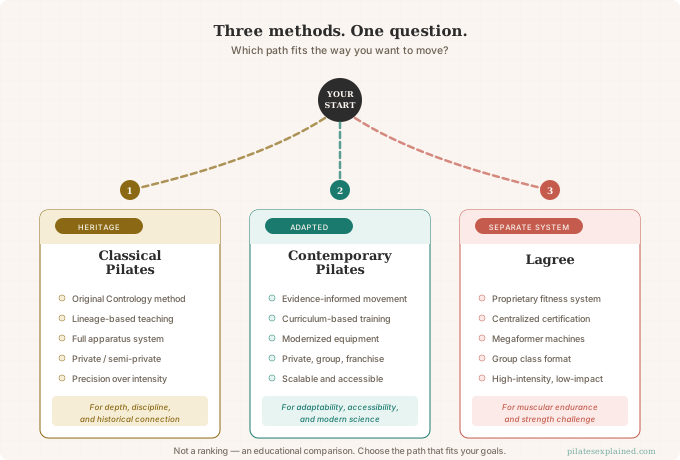
If you've been following this series, you now know the history. You understand that Classical and Contemporary Pilates are two branches of the same tree — same founder, same equipment family, different emphasis. And you know that Lagree is a separate system entirely — inspired by spring resistance, but built around different goals, different equipment, and a different business model.
Now the practical question: which one should you actually try?
Our answer: there's no single best method. The right choice depends on what you value, what your body needs right now, and what kind of experience you're looking for. Here's how to think it through.
Match Your Goals to the Method
If you value historical depth and system integrity
Classical Pilates gives you the original method in its most preserved form. Sessions follow a coherent, ordered progression through the full apparatus system — Reformer, Cadillac, Wunda Chair, barrels — guided by a teacher whose training traces back through the Elders to Joseph and Clara Pilates.
This is the choice for people who want a close teacher-student relationship, who appreciate the discipline of a system that builds on itself, and who are curious about the historical roots of the method. Classical studios tend to be smaller and more intimate. Sessions are typically private or semi-private, which means more individual attention and a more personalized progression.
What to expect in your first session: A full-body introduction to the mat work and potentially the Reformer. The teacher will assess your movement, introduce the breathing method, and begin building the foundation of the classical progression. Expect precision, not exhaustion.
Typical setting: Independent boutique studios with classical apparatus. Sessions priced as privates or semi-privates.
If you value adaptability and accessibility
Contemporary or Modern Pilates gives you evidence-informed movement with options for every body, every limitation, and every budget. Contemporary instructors may modify exercises around your anatomy, draw on rehabilitation science, and offer formats from intimate private sessions to group classes with up to twelve people on reformers.
This is the choice for beginners who want an approachable entry point, for people working with injuries or limitations who need modification-friendly instruction, and for anyone who wants the convenience of franchise accessibility or membership-based pricing.
What to expect in your first session: At a franchise studio like Club Pilates, you'll join a group reformer class with up to twelve participants. The instructor will cue the class through a sequence of exercises, offering modifications as needed. At an independent contemporary studio, you might start with a private assessment. Either way, expect a welcoming environment with clear instruction.
Typical setting: Ranges from independent educator studios to large franchise operations. Group classes, privates, and membership tiers all common.
If you value high-intensity challenge with low impact
Lagree gives you a strength-endurance workout on a proprietary machine. The slow tempo, continuous tension, and emphasis on muscular fatigue make this the choice for people who want to feel challenged, push toward physical intensity, and sweat — without the joint impact of running, jumping, or heavy lifting.
Important context: Lagree's evidence base is still young, and its marketing claims currently exceed what independent research has confirmed. That doesn't mean it won't work for you. It means you should evaluate it the way you'd evaluate any fitness claim — with curiosity and healthy skepticism.
What to expect in your first session: A 40- to 50-minute group class on a Megaformer. The instructor will guide the room through a sequence of exercises at a slow, controlled tempo. You'll feel your muscles shaking. You'll sweat. The experience is closer to a strength-endurance circuit than to a traditional Pilates session.
Typical setting: Licensed Lagree studios with proprietary equipment. Group class format.
Questions to Ask Before Booking
No matter which method interests you, asking the right questions before your first session will help you find a better fit. Here's what to look for:
About the instructor. What certification does the teacher hold? For classical Pilates, look for lineage-based training connected to one of the Elder schools. For contemporary Pilates, look for recognized programs like STOTT, BASI, Balanced Body's comprehensive path, or Club Pilates' 500-hour training. For Lagree, look for Lagree Academy certification.
About the format. Is this a private, semi-private, or group class? How many people will be in the room? If you're new to movement, a smaller setting or a private introductory session can make a big difference.
About the equipment. What apparatus will be used? Understanding the history of the Reformer, the Cadillac, and the Wunda Chair will help you appreciate what you're working with — and recognize how each piece of equipment serves the method differently.
About modifications. Are modifications offered for beginners or for people with injuries? This is especially important in group settings, where the instructor's ability to see and adjust individual participants varies.
About the studio's philosophy. Is this studio method-focused, fitness-focused, or rehab-focused? There's no wrong answer, but knowing the orientation helps you set the right expectations for what you'll experience.
The Honest Truth — Try More Than One
Methods are not religions. You don't have to pledge allegiance to one approach and ignore the others.
Many practitioners benefit from exposure to more than one tradition. A classical session teaches you discipline, system thinking, and the satisfaction of working within a coherent method. A contemporary class teaches you adaptability and helps you understand how the principles apply to your specific body. A Lagree class teaches you about endurance and fatigue thresholds in a completely different context.
The methods serve different purposes. Your body may benefit from different approaches at different stages of life. A beginner might start with contemporary group classes for accessibility and affordability, then discover classical Pilates years later and fall in love with the depth of the original system. Someone training for a marathon might use Lagree for low-impact strength work in the off-season and return to Pilates for mobility and coordination during race prep.
The point is: understanding what each method actually is — where it came from, what it's designed to do, and how it's governed — gives you the information you need to choose well. Not once, but every time you're ready for something new.
Ready to Take the Next Step?
Ready to try the method? Here are two ways to find classes near you:
This is the final post in our three-part series, "Three Methods, One Question." Start from the beginning with Classical and Modern Pilates — Same Roots, Different Branches, or read the middle chapter: What Is Lagree? (And Why It's Not Pilates).
Still deciding? Get our free Pilates Starter Decision Guide - a short guide to choosing between mat, reformer, online, and studio Pilates.
Before you book
If you are deciding today, start with what you need most: historical depth, adaptable instruction, or high-intensity strength endurance. Then use the studio questions in this article before committing to a package.
Quick questions
Is Lagree a type of Pilates?
Lagree is Pilates-adjacent, but it is a separate branded fitness method with its own equipment, pacing, and business model.
Should beginners choose classical or contemporary Pilates?
Beginners can start with either. Classical work emphasizes a more inherited sequence, while contemporary studios often adapt the method for varied bodies, settings, and goals.
What is the easiest first step?
Choose the setting you will actually attend: a beginner mat class, an introductory Reformer session, or a well-labeled online program with clear instruction.
Free guide
Get the Pilates Starter Decision Guide
Still choosing between class styles, equipment, and studio language? The free guide turns the history into a practical first-class decision.
Powered by MailerLite. You can unsubscribe at any time.