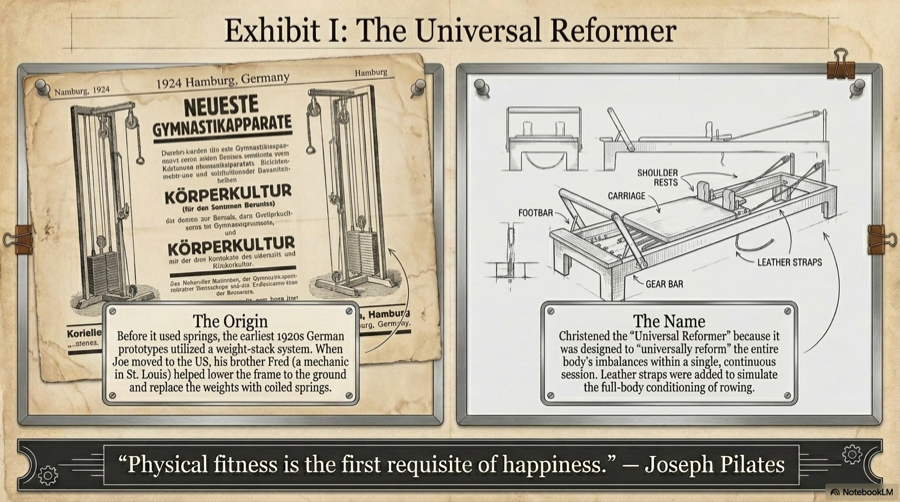
The Reformer is often the first equipment people associate with Pilates: a sliding carriage, adjustable springs, straps, pulleys, shoulder blocks, and a footbar. Its genius is that it makes resistance mobile. The body does not push against a fixed weight stack. It negotiates a moving platform that rewards control and exposes compensation.
Historically, the Reformer sits at the intersection of two Pilates ideas. The first is rehabilitation: springs can assist a person who cannot yet control a full movement alone. The second is athletic precision: the same springs can challenge a strong mover to coordinate the whole body without collapsing into momentum.
The carriage is what makes the machine visually memorable. It glides, but it does not glide freely. The springs pull it back. The practitioner must organize the spine, pelvis, ribs, shoulders, and limbs while the machine keeps asking for a cleaner relationship between effort and control.
Why springs changed the method
Traditional weights become heaviest in predictable ways. Springs change as they stretch. That elastic resistance can make a movement feel alive: assistance at one point, challenge at another, feedback throughout. This is why the Reformer can be useful for beginners and advanced practitioners at the same time.
In a history site, the Reformer deserves more than a product description. It should be explained as a design philosophy. Joseph Pilates was building furniture that taught. The machine asks the user to feel timing, rhythm, and alignment through resistance.
The search opportunity
"Reformer Pilates" is one of the strongest modern search phrases in the category. A history article can capture that interest while offering something different from studio marketing: the origin, mechanical logic, and historical meaning of the machine.
Quick questions
Why is the Reformer so associated with Pilates?
The Reformer turns spring resistance and a moving carriage into a clear physical expression of the method: support, feedback, alignment, and controlled effort.
Is a Reformer required for Pilates?
No. Mat Pilates is part of the method and can be powerful on its own. The Reformer adds resistance and feedback, but it is not the only way to practice.
Is a home Reformer a beginner purchase?
Usually not immediately. Most beginners should take instruction first, then decide whether the cost, space, and safety requirements make sense at home.
Free guide
Get the Pilates Starter Decision Guide
Still choosing between class styles, equipment, and studio language? The free guide turns the history into a practical first-class decision.
Powered by MailerLite. You can unsubscribe at any time.
Try it today
Want to try a Reformer?
Take one taught session before buying equipment. A teacher can help you understand spring setup, transitions, and whether this apparatus fits your body and goals.
Sources and further reading
- Britannica: Pilates.
- Pilates Method Alliance: Pilates History.
- Project source: The Pilates Blueprint, slide deck.