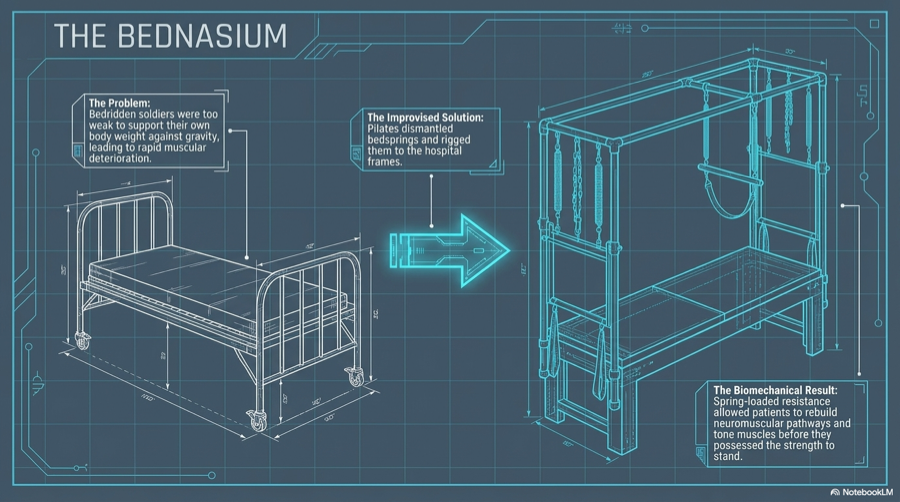
During World War I, Joseph Pilates was interned in Britain as an enemy alien. The Pilates Method Alliance describes this period as formative: he taught exercise routines in camp and developed ideas about fitness through daily practice and instruction. This is where Pilates history becomes dramatically different from most fitness origin stories.
The internment story matters because it explains the method's obsession with constraint. Limited space, limited equipment, injured bodies, and institutional conditions all push the same question: how can a person maintain strength, coordination, and dignity when circumstances are restricted?
Later histories often connect this period to hospital-bed exercises and the use of bed springs for resistance. That image is powerful because it anticipates the whole equipment ecosystem. A spring can resist, assist, guide, and reveal motion. It can help a weak body move, or make a strong body work with more precision.
Why the origin hook works
"Pilates began in a prison camp" is not just a dramatic line. It clarifies the emotional logic of the method. Pilates was not originally marketed as a luxury studio practice. It was tied to rehabilitation, self-mastery, and physical culture in a difficult historical moment.
For a modern audience, this gives the site a strong editorial advantage. Many people discover Pilates through reformer classes or social media, but the origin story gives the method depth. It reframes the equipment as an answer to a serious problem: how to train the body intelligently when ordinary training conditions are unavailable.
What to handle carefully
The history should avoid overstating details that are difficult to prove. Some retellings make the internment camp sound like a fully formed Pilates studio. A more credible version is better: the camp was a teaching and experimentation period. The mature equipment and New York studio came later, but the logic of spring resistance and disciplined movement can be traced back to those conditions.
Quick questions
Did Pilates begin in an internment camp?
The internment period is central to the origin story because Joseph Pilates taught and refined movement ideas under wartime confinement. Later accounts connect that period to bed-based and spring-resistance experiments.
Is every part of the origin story proven?
Not every detail is documented with equal strength. A careful history treats the camp story as influential and important while separating well-supported facts from later legend.
How did confinement shape the equipment?
Constraint made support, resistance, and adaptation practical problems. Those ideas later became visible in equipment such as the Cadillac and Reformer.
Free guide
Get the Pilates Starter Decision Guide
Still choosing between class styles, equipment, and studio language? The free guide turns the history into a practical first-class decision.
Powered by MailerLite. You can unsubscribe at any time.
Sources and further reading
- Pilates Method Alliance: Pilates History.
- Britannica: Pilates.
- Project source: The Biomechanical Dossier, slide deck.