Joseph Hubertus Pilates was born in Monchengladbach, Germany, in 1883. The standard biography begins with illness: asthma, rickets, and physical weakness in childhood. Whether every detail of the legend can be documented with equal certainty, the story matters because Pilates made physical transformation the core of his identity.
He grew into the culture of turn-of-the-century physical training. Gymnastics, boxing, wrestling, self-defense, bodybuilding, and movement study all shaped his thinking. That mixture gave his later method its unusual character. It was not just calisthenics, not just rehabilitation, and not just dance conditioning. It borrowed from several worlds and fused them into a practice of controlled strength.
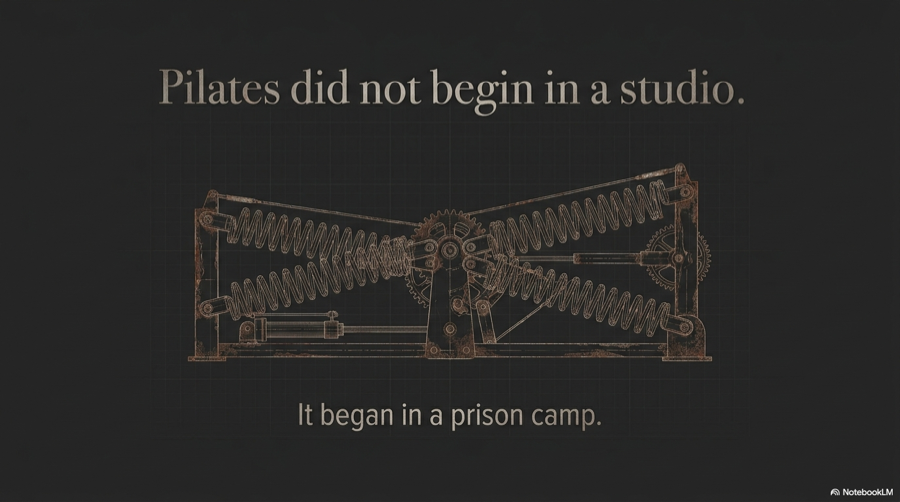
Pilates traveled to England before World War I and worked in performance and physical training contexts. When war broke out, he was interned as a German enemy alien. The internment period became central to the Pilates origin story because it forced him to teach and refine his ideas under constraint. Later accounts connect this period to early spring-resistance equipment and bed-based rehabilitation experiments.
The New York studio
In the 1920s, Joseph Pilates moved to New York and opened a studio with Clara Pilates. Their space on Eighth Avenue became a practical workshop for the method. It attracted dancers, performers, and people seeking strength with control rather than bulk. Clara's role matters here: she helped sustain the teaching culture and interpret the work for students long after Joseph's ideas had begun to spread.
Pilates was also an inventor. The equipment he designed gave his method a visual and mechanical identity: springs, straps, carriages, frames, chairs, barrels, and adjustable resistance. These tools made the body visible as a system of leverage, alignment, and control.
Why his biography still works online
For search and storytelling, Joseph Pilates is unusually strong material. His life includes illness, self-reinvention, war, immigration, invention, dance culture, entrepreneurship, and a method that outlived its founder. A richer history site should use those details carefully: not as mythmaking, but as a way to show why the method carried emotional force before it became a global industry.
Quick questions
What was Joseph Pilates known for?
Joseph Pilates was known as the founder of Contrology, the movement method now usually called Pilates, and as an inventor of spring-based exercise apparatus.
Did Clara Pilates help create the method?
Clara Pilates was essential to the studio's teaching culture and continuity. Joseph is usually named as the founder, but Clara helped interpret and sustain the work for students.
Why did dancers become important to Pilates history?
Dancers found value in a method that built strength, control, and recovery without sacrificing coordination or mobility, so they became an important transmission channel.
Free guide
Get the Pilates Starter Decision Guide
Still choosing between class styles, equipment, and studio language? The free guide turns the history into a practical first-class decision.
Powered by MailerLite. You can unsubscribe at any time.
Sources and further reading
- Pilates Method Alliance: Pilates History.
- Britannica: Pilates.
- Project source: The Biomechanical Dossier, slide deck.