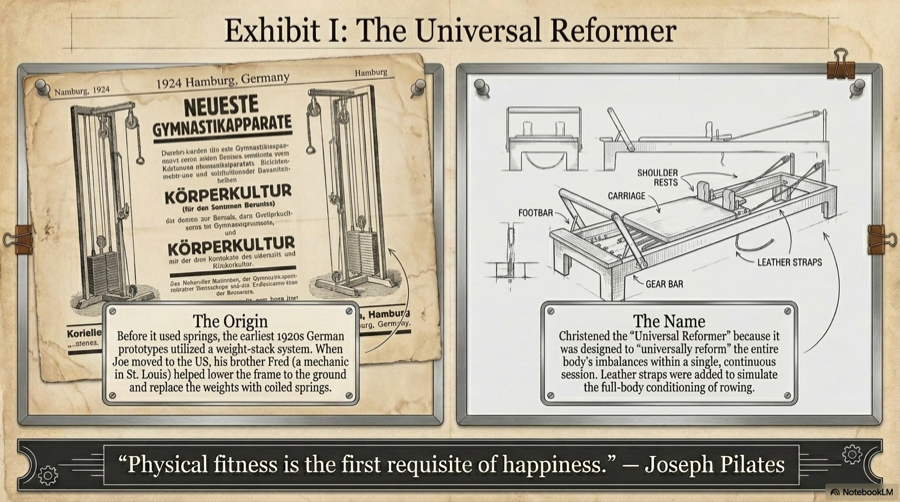
You may already know that Joseph Pilates called the method Contrology, that the Reformer uses springs instead of weights, or that dancers helped the method spread. What you still may not know is the thing your body actually cares about: what it feels like to walk in the door and do this for the first time.
The honest answer is less dramatic than the studio photos make it look. A first Pilates class is usually slower, quieter, and more focused than a typical fitness class. You spend a lot of it learning where your ribs, pelvis, spine, shoulders, and breath are in space.
The short answer
You will not be expected to be flexible, strong, or coordinated already. You will probably leave feeling worked but not wrecked, with the slightly humbling realization that small movements can be surprisingly hard.
Before you go
- Wear close-fitting, stretchy clothing. Loose tops can shift during inversions and make it harder for the teacher to see your alignment.
- Ask about grip socks. Many studios require them for hygiene and traction on mats and equipment.
- Arrive 10 to 15 minutes early. First-timers often fill out a health form and get a quick equipment orientation.
- Eat lightly. Flexion, rotation, and abdominal work feel better when you are not overly full.
- Tell the instructor about injuries, surgeries, pregnancy, or major concerns. Good teachers use that information to modify the work around your body.
Mat or Reformer: different first impressions
"Pilates" might mean a floor mat class or a class on the spring-loaded Reformer, and your first impression depends on which one you booked.
A mat class uses your own body weight, sometimes with small props such as a ring, band, or small ball. It is the most portable form of the method and can feel deceptively hard because there is very little equipment to hide behind.
A Reformer class puts you on a moving carriage with adjustable springs, straps, and a footbar. The springs both challenge and support you, which is why the Reformer can feel approachable and genuinely difficult at the same time.
Worth keeping straight: Lagree or "Megaformer" classes are a separate proprietary system, not Pilates. They often use spring-based machines but tend to be programmed as high-intensity strength-endurance classes.
What you will actually do
Classes vary by teacher and tradition, but a first session usually moves through a recognizable arc.
- Settling and breath. You start by finding a position and coordinating breath with movement.
- Warm-up and orientation. You may mobilize the spine and pelvis, then learn how the Reformer carriage, straps, and springs respond.
- Main work. Expect controlled, low-to-moderate movements that link breath to motion. The emphasis is precision, not speed.
- Wind-down. Many classes close with stretching, decompression, or a simpler movement pattern so you can feel what changed.
The cues you will hear
Instructors share a vocabulary that can sound like a private language on day one. Here is the quick decoder.
- "Find your powerhouse." Engage the deep trunk muscles that help organize the spine and pelvis.
- "Navel to spine" or "scoop." Draw the lower belly inward without holding your breath or gripping.
- "Neutral pelvis" or "neutral spine." Keep the natural curve of the lower back instead of forcing a tuck or arch.
- "Articulate the spine." Move through the spine sequentially, one segment at a time.
- "C-curve." A rounded, scooped shape through the back.
- "Lengthen." Create direction and space rather than simply contracting harder.
If a cue does not land, ask the teacher to show you. Good instructors expect questions from first-timers.
How you may feel during and after
During class, the most common surprise is mental: the focus can feel more like a balance or coordination challenge than a sweaty cardio grind. Afterward, mild next-day soreness in the deep core, inner thighs, or upper back is common. Sharp pain, radiating pain, or joint pain is different from honest muscle fatigue; stop and tell the instructor if something feels wrong.
Common worries to retire
- "I am too inflexible." Flexibility is one possible outcome of practice, not a prerequisite.
- "I am too out of shape." The method can be scaled down or up.
- "I will be the only beginner." Most beginner-friendly classes include mixed experience levels.
- "I will embarrass myself on the machine." Everyone fumbles the straps the first time. That is why orientation exists.
Next step
Still choosing between mat, Reformer, online, or studio?
The starter decision guide walks through the tradeoffs and rough costs without pushing a particular studio.