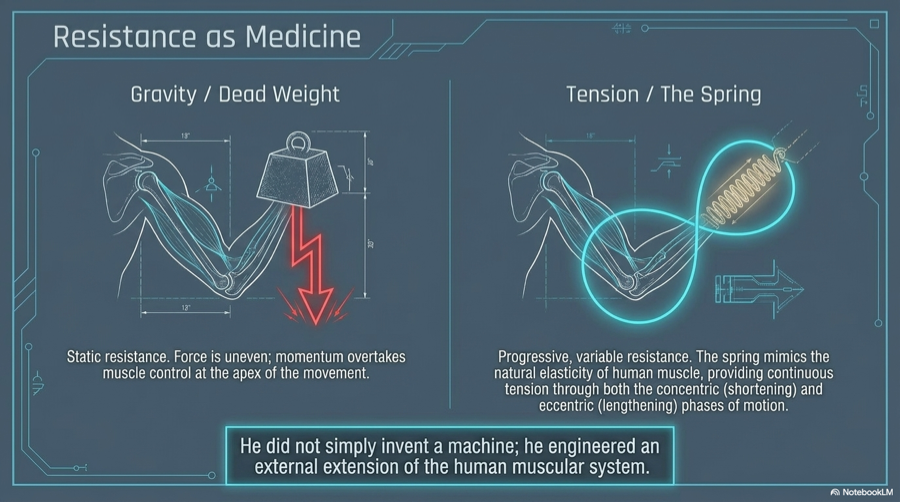
Pick up a weight and gravity does the simple part: it pulls down. The load may be light or heavy, but the direction is fixed. A spring behaves differently. The further you pull it, the more it resists, and that resistance follows the line of the movement rather than only pointing toward the floor.
Joseph Pilates built that idea into the Reformer. Springs under a sliding carriage can support a movement and challenge it at the same time, which is why the machine can feel strangely helpful and demanding in the same exercise.
The Reformer turns resistance into feedback
The main parts are simple once you know what you are looking at: carriage, springs, footbar, shoulder rests, headrest, straps, and rails. Together they create a moving platform that responds to how smoothly you organize your body.
If you push unevenly, the carriage tells you. If you lose control, the spring changes how the movement feels. If you coordinate breath, alignment, and effort, the whole machine starts to feel quieter.
Support and challenge, together
In a first class, the most helpful thing about spring resistance may be support. The springs can hold part of your weight while you learn a pattern, which can make certain movements feel more approachable than doing them unsupported on a mat.
That does not make the Reformer easy. The same spring system can ask for more strength, more precision, or more balance as the teacher changes the setup. The point is not to add weight endlessly. The point is to tune the resistance to the task.
Lighter springs are not always easier
This is the counter-intuitive part. A lighter spring can sometimes make an exercise harder because it gives you less to push against. With less assistance from the machine, your own control has to do more of the work.
That is why Reformer settings are not a simple beginner-to-advanced ladder. Spring choices depend on the exercise, the person, the goal, and the teacher's eye.
What beginners should remember
- Springs create resistance that changes through the movement.
- The same spring can support one exercise and challenge another.
- More springs do not always mean better work.
- Less spring does not always mean easier work.
- The teacher changes the setup to shape control, not just effort.
Try it visually
Meet the Reformer before class
Use the interactive explorer to identify the carriage, springs, straps, and footbar before you see the machine in a studio.
Open the Reformer explorerSources and further reading
- Pilates Explained: History of the Reformer.
- Joseph Pilates and William J. Miller, Return to Life Through Contrology, 1945.