Contrology is the best starting point for understanding Pilates because it reveals the ambition of the original system. Joseph Pilates was not trying to brand a boutique workout. He was describing a method of self-command: the mind directing the body with accuracy, breath, rhythm, and intention.
The modern word "Pilates" often points people toward equipment classes, reformer studios, or low-impact strength training. Contrology points in a slightly different direction. It suggests that the point is not the equipment itself, but the quality of attention that passes through it. The exercise is only successful when the practitioner can coordinate breath, alignment, concentration, and controlled effort.
That distinction matters for a history site because it separates the method from generic fitness. Many exercise systems promise exertion. Contrology promises refinement. The work asks whether the spine moves clearly, whether the breath supports the movement, whether the center of the body organizes the limbs, and whether the person can repeat the action without strain or collapse.
Why the name changed
Joseph Pilates published Return to Life Through Contrology in 1945 with William J. Miller. The book set out a mat sequence and an argument for daily physical practice. Over time, however, students, studios, and the public used the founder's name as the easier shorthand. "Pilates" survived because it was memorable, personal, and simple.
The cost of that simplification is that the philosophy can disappear. A class can be called Pilates while drifting away from the older emphasis on control, whole-body coordination, and exactness. That does not automatically make contemporary Pilates wrong, but it does create a useful historical question: what remains of Contrology when the name is gone?
The six ideas to track
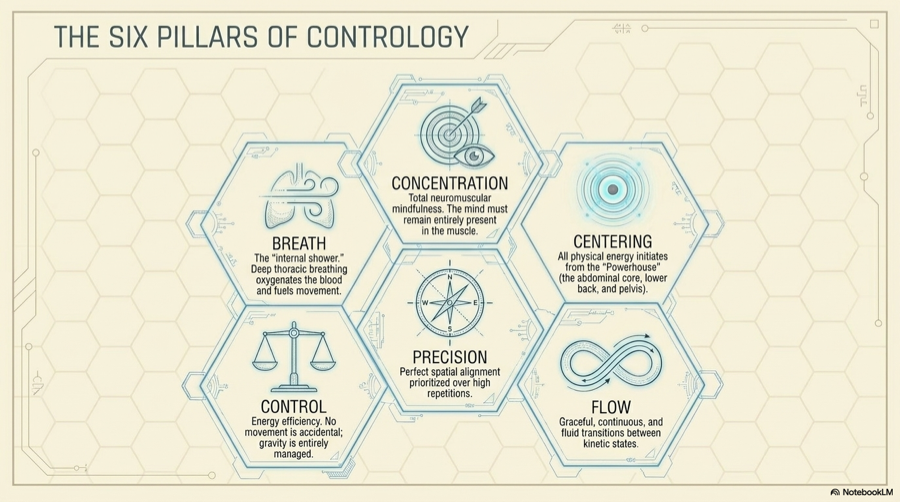
Most modern explanations organize the method around principles such as breath, concentration, centering, control, precision, and flow. These are not just inspirational words. They are a way to judge whether the exercise is doing what the method claims. A movement with no concentration becomes choreography. A movement with no breath becomes bracing. A movement with no precision becomes repetition for its own sake.
For the History of Pilates project, Contrology should become the site's interpretive lens. Every equipment page, biography page, and timeline entry can ask the same question: how did this invention, teacher, or historical moment advance Joseph Pilates' larger goal of coordinated control?
Quick questions
Is Contrology the same as Pilates?
Contrology was Joseph Pilates' name for the method. Pilates is the name most people use today, but Contrology points back to the original emphasis on concentration, breath, precision, and whole-body control.
Was Contrology only mat exercise?
No. Mat work was central, but the larger method also included apparatus that used springs, straps, and support to teach the same movement principles.
Why does the old name matter?
The old name helps explain that Pilates was designed as a disciplined movement system, not simply a collection of fitness exercises.
Free guide
Get the Pilates Starter Decision Guide
Still choosing between class styles, equipment, and studio language? The free guide turns the history into a practical first-class decision.
Powered by MailerLite. You can unsubscribe at any time.
Sources and further reading
- Joseph Pilates and William J. Miller, Return to Life Through Contrology, 1945.
- Pilates Method Alliance: Pilates History.
- Britannica: Pilates.