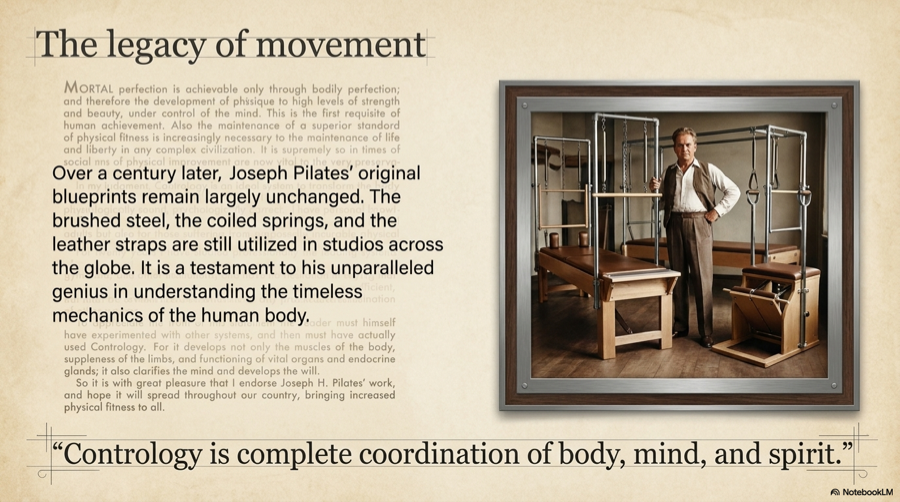
Pilates history is unusually readable because the founder left books, apparatus, photographs, and a strong studio lineage. The challenge is not finding a single official text that explains everything. The challenge is reading across original sources, later teachers, and modern anatomy without flattening them into one voice.
This list begins with Joseph Pilates' own books, then moves to respected modern references. It is not a certification curriculum and it is not a ranking. It is a practical shelf for readers who want to understand what changed as Contrology became Pilates.
The original texts
Your Health (1934) is the broader manifesto. It is opinionated, sometimes strange by modern standards, and useful precisely because it shows Joseph Pilates' health philosophy before the method became a global studio brand. Read it for context, not as modern medical guidance.
Return to Life Through Contrology (1945), created with William John Miller, is the compact exercise text most readers associate with the original mat sequence. It is short, direct, and historically important. Read it slowly. The sparseness is part of the lesson: the method assumes attention, repetition, and control.
Modern references
The Pilates Body by Brooke Siler helped introduce many mainstream readers to a classical vocabulary. It is useful for seeing how the method was translated for home readers during Pilates' wider commercial expansion.
Pilates by Rael Isacowitz is often valued for a contemporary, teacher-friendly presentation of exercises and apparatus. It belongs on the shelf when you want structured explanation rather than founder-era rhetoric.
Annotated or illustrated editions of the original work can also be helpful, especially when they make the old sequence more legible. The key is to notice what is annotation and what is original text. A good modern edition should help you read the source, not hide it.
| Book type | Why it matters | How to read it | Search |
|---|---|---|---|
| Founder texts | Original voice, philosophy, and early exercise presentation. | As historical source material. | Check current editions |
| Classical introductions | Shows how the inherited method reached mainstream readers. | As interpretation and teaching translation. | Check current editions |
| Comprehensive manuals | Useful for anatomy, apparatus organization, and teacher reference. | As modern professional guidance. | Check current editions |
A reading order
Start with the short original exercise text, then read the broader 1934 philosophy, then compare a modern classical introduction with a contemporary manual. That order keeps the founder's voice visible while making room for the method's later development.
For teachers, the most important habit is citation discipline. If a claim comes from Joseph Pilates, say so. If it comes from a later teacher, say that. If it is a modern teaching convention, do not present it as an archival fact.
Related reading: Your Health, Contrology, and the Pilates Elders and lineage.
Quick questions
What should I read first?
Start with Return to Life Through Contrology if you want the compact original exercise text, then read Your Health for the broader philosophy.
Are modern Pilates books still useful?
Yes, especially when they clarify anatomy, teaching language, or contemporary practice. Read them as interpretations, not replacements for historical sources.
Should teachers own the original books?
Teachers benefit from reading the originals directly because they show Joseph Pilates' voice, assumptions, and historical context.