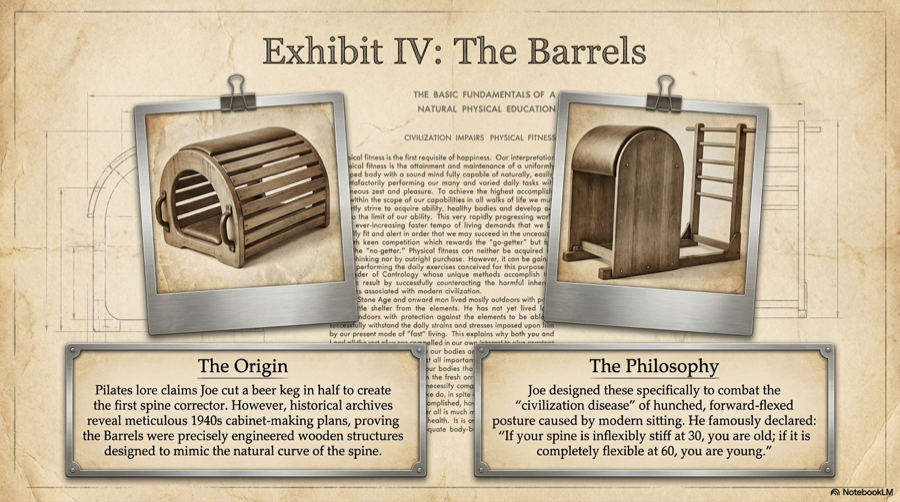
The Pilates barrels are quieter than the Reformer, but they may be the most direct expression of Joseph Pilates' interest in spinal shape. A barrel gives the body an arc. That arc can support extension, open the front of the body, challenge the abdominals, and teach the spine to move segment by segment rather than as one stiff block.
Modern life makes this topic search-relevant. People sit, round forward, work at screens, and then search for posture correction, back relief, mobility, and "tech neck" answers. A history article on barrels can connect that modern demand to an older equipment logic: shape the environment so the body can rediscover movement it has lost.
The barrels also show that Pilates equipment was never just about resistance. Some equipment pulls with springs. Some equipment glides. The barrel changes geometry. It creates a curved surface that asks the spine to relate to gravity differently.
The small equipment with a large idea
Barrels come in several forms, including ladder barrels, spine correctors, and smaller arcs. Each one changes scale and support, but the family resemblance is clear. The body is invited into extension, lateral flexion, rotation, and deep abdominal control.
For the site, the barrels are useful because they broaden the equipment story. Without them, visitors may assume Pilates equipment is only about reformer springs. The barrels show another side of the method: posture, breath, spinal articulation, and shape.
Free guide
Get the Pilates Starter Decision Guide
Still choosing between class styles, equipment, and studio language? The free guide turns the history into a practical first-class decision.
Powered by MailerLite. You can unsubscribe at any time.
Try it today
Want to try a Barrels and Spinal Decompression?
Take one taught session before buying equipment. A teacher can help you understand spring setup, transitions, and whether this apparatus fits your body and goals.
Sources and further reading
- Britannica: Pilates.
- Project source: The Pilates Blueprint, slide deck.
- Project source: Pilates SEO and Content Strategy, Google Doc.